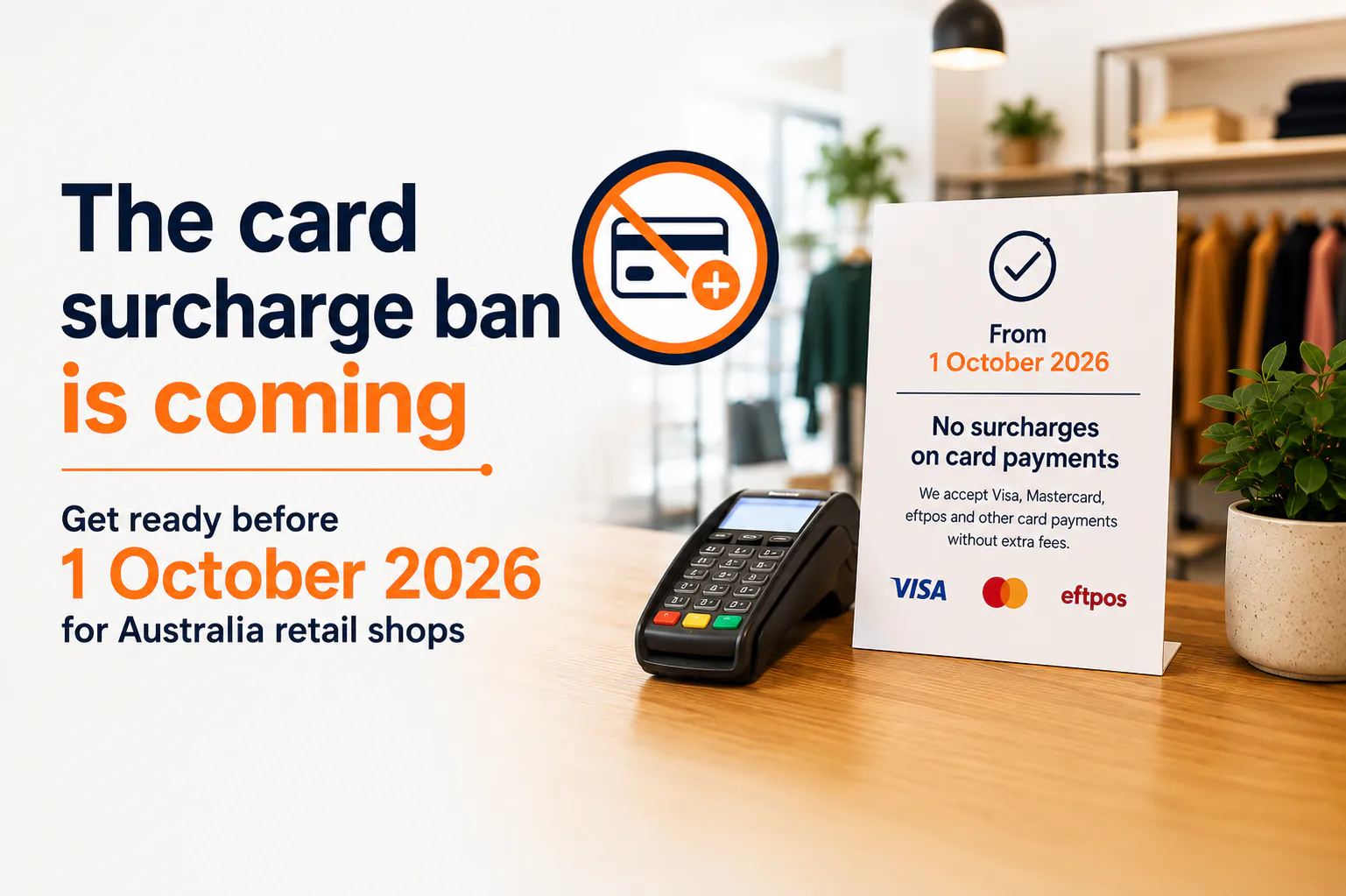

On Thursday 1 October, the card surcharge comes off the receipt. Your Saturday price, your public holiday price, and your booking deposit do not go with it.
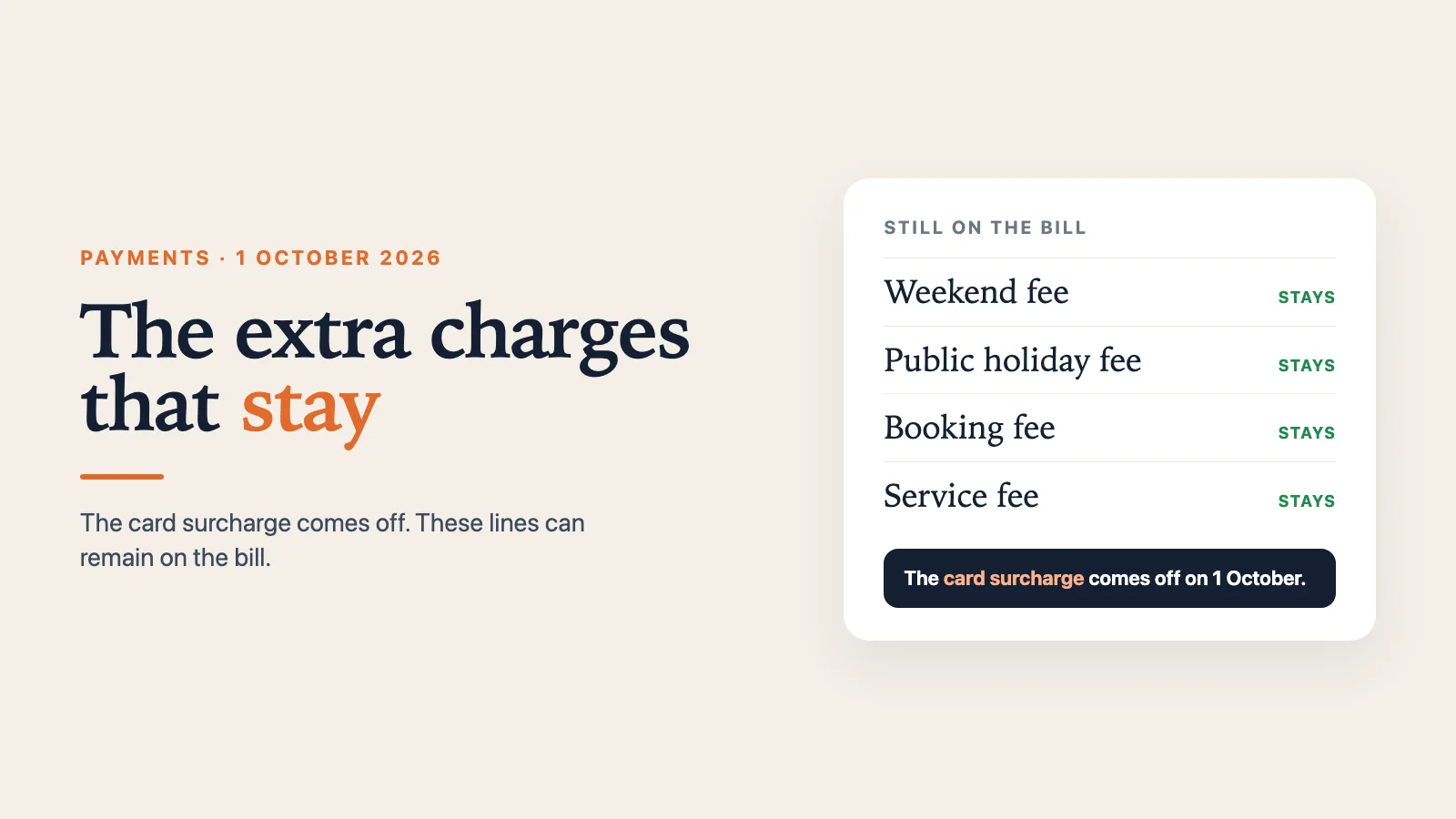
From 1 October 2026, a fee you add because someone pays by card has to go. A weekend fee, a public holiday fee, a booking fee, and a service fee can stay. Here is the difference, and what to change before that date.
The line that comes off
A card surcharge is an extra amount added because the customer paid by card. From 1 October 2026 that extra amount ends on eftpos, Visa, Mastercard, and American Express. UnionPay is the same day. PayPal follows on 5 October 2026.
It covers debit, prepaid, and credit, in the salon and online. If the terminal adds a percentage at the tap, switch that off. The price on the booking and the price on the receipt should match.
Your merchant fee is still there. The amount that lands in the bank will be a little smaller than the amount on the screen. Folding that cost into your prices is a separate job, and the steps are in the card surcharge ban guide.
One date catches people out. A client can pay an old invoice by card on or after 1 October. The card surcharge on that payment may already be unavailable. Ask your payment provider before you send the link.
The lines that stay
The Reserve Bank has drawn this in plain terms. The change does not apply to a weekend surcharge, a public holiday surcharge, a booking fee, or a service fee. business.gov.au says the same, and adds other charges that have nothing to do with the card.
A weekend fee is a higher price for Saturday or Sunday, and it applies however the client pays. A public holiday fee works the same way. Hospitality businesses can still use those charges where they are permitted.
A weekend fee is a real Saturday or Sunday price. An amount that appears only when someone taps a card is a card surcharge, including on a Monday.
A service fee that every client pays, cash or card, can stay. A service fee that shows up only on card payments is a card surcharge.
Leave the booking deposit alone
A booking deposit is part of the price of the appointment, taken early so the chair is held. It is not a card surcharge. Leave it on.
Some tills also add a percentage because that deposit is paid by card. That percentage is the line that goes. The deposit stays.
A booking fee, a charge for making the booking itself, sits outside this ban too. Same test. It applies because they booked, not because of the card they used.
A lower cash price can stay
You can still offer a lower price for cash, or for another payment method you would rather take. The Reserve Bank says a discount for a payment method can stay.
Keep the two prices apart. The price in the window is $80, and cash pays $78. That is a discount. The window says $78, and the tap becomes $80. That extra $2 is a card surcharge.
If you do offer a cash price, check the sign against the ACCC guidance on price displays, so the window and the screen tell the same story.
What to do before 1 October
- Switch off the card surcharge in your terminal, and on any booking page that adds one. Take a test payment. The receipt should show no card fee.
- Leave the weekend fee, the public holiday fee, and the booking deposit where they are.
- Open a booking deposit paid by card and confirm there is no card percentage sitting on top of it.
- If you want to favour cash, show a lower cash price. A fee added at the tap is a card surcharge.
- Give the counter one sentence: "Card payments are the price on the screen. Saturday prices and booking deposits stay."
Many payment providers will turn surcharging off on their terminals around 1 October. Ask yours what they are doing, so you are not hunting for a button they have already removed.
If you take card payments in Weeklify, switch that card surcharge off before 1 October. Your service prices and booking deposits stay as they are.
If you only do one thing
Remove the line that exists because of the card. Keep the lines that exist because of the day, the booking, or the service.
This is general information, not legal or financial advice. Network rules can still shift. For your own till, read the Reserve Bank's FAQ and ask your payment provider.
Sources: RBA — Removal of card payment surcharges from 1 October 2026, FAQ; business.gov.au — Card payment surcharge changes are coming; ACCC — Card surcharges.
The Weeklify team writes about payments, POS and the day-to-day of running a service business in Australia.
Run a calmer, fuller salon.
Everything you just read is built into Weeklify. Start your three months free — no credit card.