

That little "1.5% card surcharge" line on your receipts? It's about to disappear for good.
From 1 October 2026, you won't be allowed to add a surcharge to most card payments. For some owners that's a relief. For others it's a quiet hit to the margin. Either way, the businesses that prepare early will barely feel it — and this article gives you the plan.
What the RBA actually decided
On 31 March 2026, the Reserve Bank of Australia confirmed the change. This isn't a proposal or a "maybe" — it's locked in. Three things are happening at once.
Surcharging is going. You can no longer pass card costs on to customers on the eftpos, Mastercard, and Visa networks — debit, prepaid, or credit. The price you display is the price they pay.
Interchange fees are being cut. These are the wholesale fees you pay to accept cards. They're dropping, and small businesses should benefit most, because you tend to pay closest to the current caps.
Fees are getting more transparent. Card networks and providers face new disclosure rules, so it'll be easier to compare deals and switch.
All up, the RBA estimates the reforms could save consumers and businesses up to $1.8 billion a year.
When it kicks in
Most of it starts on 1 October 2026 — the surcharge ban and the lower interchange caps on domestic card payments.
A second wave follows on 1 April 2027: a cap on fees for foreign-issued cards, plus more transparency rules. Those got extra time because they're trickier to roll out.
Who's covered
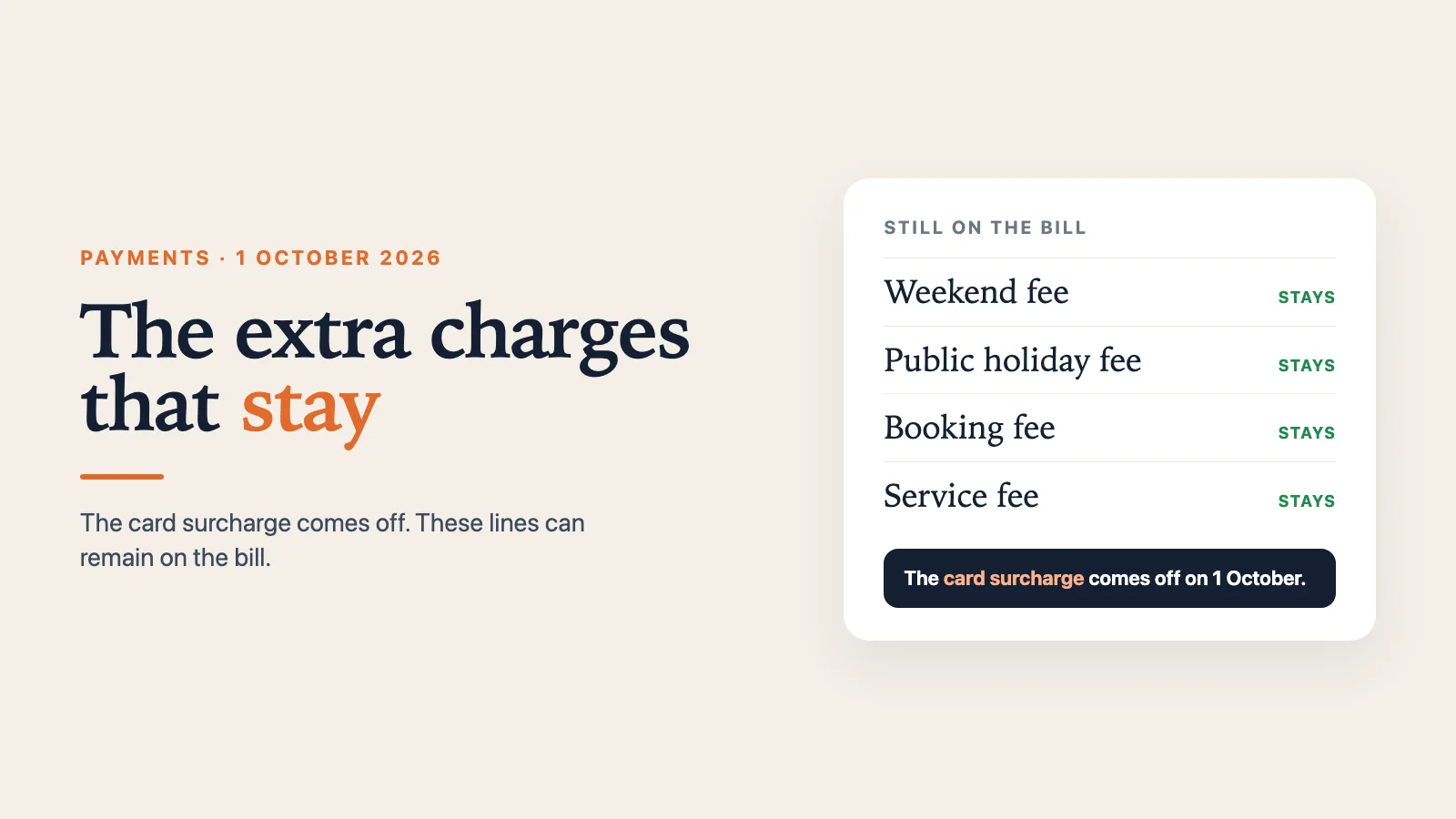
The ban applies to eftpos, Mastercard, and Visa. American Express and UnionPay have also said they will remove surcharging from 1 October 2026. PayPal's rule starts on 5 October. Weekend fees, public holiday fees, booking fees, and service fees are a different question, covered in the extra charges that stay on 1 October.
One more thing to watch: the RBA plans to consult from mid-2026 on areas it hasn't touched yet, including mobile wallets and buy-now-pay-later. So more change may follow.
The myth worth busting: your fees aren't gone
Here's where a lot of owners get caught out. The ban doesn't remove your merchant fees — it just stops you charging them to the customer.
You'll still pay to accept cards. You simply can't itemise that cost at the till anymore. So if nearly all your sales are now cards, and you were surcharging around 1–1.5%, that cost has to live somewhere — your prices or your margin. Better to plan that move now than spot the gap in your October takings.
Your pre-1-October checklist
- Know your real cost of acceptance. Pull your last few merchant statements and work out your fees as a percentage of card turnover. That's the number you've been recovering — and now need to cover.
- Reprice on purpose. Decide whether to absorb the cost, build it into your prices, or split the difference. A small, even adjustment usually beats a sudden across-the-board jump.
- Switch off surcharging in your POS. Do it before the deadline and test everything — receipts, displayed prices, online checkout. Keep surcharging after 1 October and you risk losing card acceptance altogether.
- Shop around on fees. With lower caps and new transparency rules coming, ask your provider exactly what your rate will be from October. Lower interchange won't always flow through on its own.
- Update signage and brief your team. Pull down the "card surcharge applies" notices and make sure your front counter can answer questions with confidence.
Turn a compliance job into a customer win
There's an upside here. Customers genuinely prefer prices that include everything — no nasty surprise at the terminal. A clean, all-in price is simpler to advertise, easier to trust, and removes friction at the exact moment someone's deciding to buy.
The smoothest path is a cloud POS where you flip surcharging off once and the new prices push to every register and online channel at the same time — while your reports still show your true cost of acceptance, so you can price with confidence. That's the kind of change Weeklify is built to make painless. If you're on an older system, the months before October are the time to check it can handle this cleanly.
What we're telling our own customers
The deadline is fixed. Treat the next few months as a repricing-and-systems job, not a late-September scramble, and your customers won't notice a thing.
This is general information only, not financial or legal advice. For your specific situation, check the RBA's Conclusions Paper or talk to your payment provider and accountant.
Sources: RBA — Review of Merchant Card Payment Costs and Surcharging; ANZ — Australia Card Surcharge Ban 2026; Mirai Legal — RBA to End Payment Surcharges from 1 October 2026
The Weeklify team writes about payments, POS and the day-to-day of running a service business in Australia.
Run a calmer, fuller salon.
Everything you just read is built into Weeklify. Start your three months free — no credit card.